Flagship Case Study
Vaulta — Multi-Tenant Inventory & Collection SaaS Built with Laravel 13 & Livewire
Vaulta is a collaborative SaaS platform designed around multi-workspace architecture, structured inventory management and role-based workflows. This case study explores the architectural decisions behind building a Laravel-first product with workspace-scoped data, contextual authorization, member invitations, item management, tags, filters and CSV exports.
Role
Fullstack Laravel Engineer
Stack
Laravel 13, Livewire, Tailwind CSS, AlpineJS, MySQL, Docker
Project Type
Multi-tenant SaaS product
Overview
Vaulta was built as a professional SaaS project focused on collection and inventory management. Instead of treating collections as isolated user-owned records, the system is designed around workspaces: shared environments where users can organize collections, manage items, invite collaborators and work with structured metadata.
The goal was not to build the largest possible feature set, but to create a controlled and mature MVP that demonstrates real product thinking: tenant isolation, role-based access, scoped queries, clean domain modeling, business-oriented dashboards and workflows that can grow over time.
Key principle: Vaulta was designed as a product architecture exercise, not as a simple CRUD. The application is organized around workspace context, contextual ownership and clear access boundaries.
Workspace Architecture
Workspace as the Core Tenant Boundary
Vaulta uses the workspace as the central unit of ownership. Collections, items, tags, invitations and members all belong to a workspace, which makes the application easier to reason about as a multi-tenant SaaS. This avoids coupling business data directly to individual users and allows collaboration to be added naturally.
Contextual Roles and Memberships
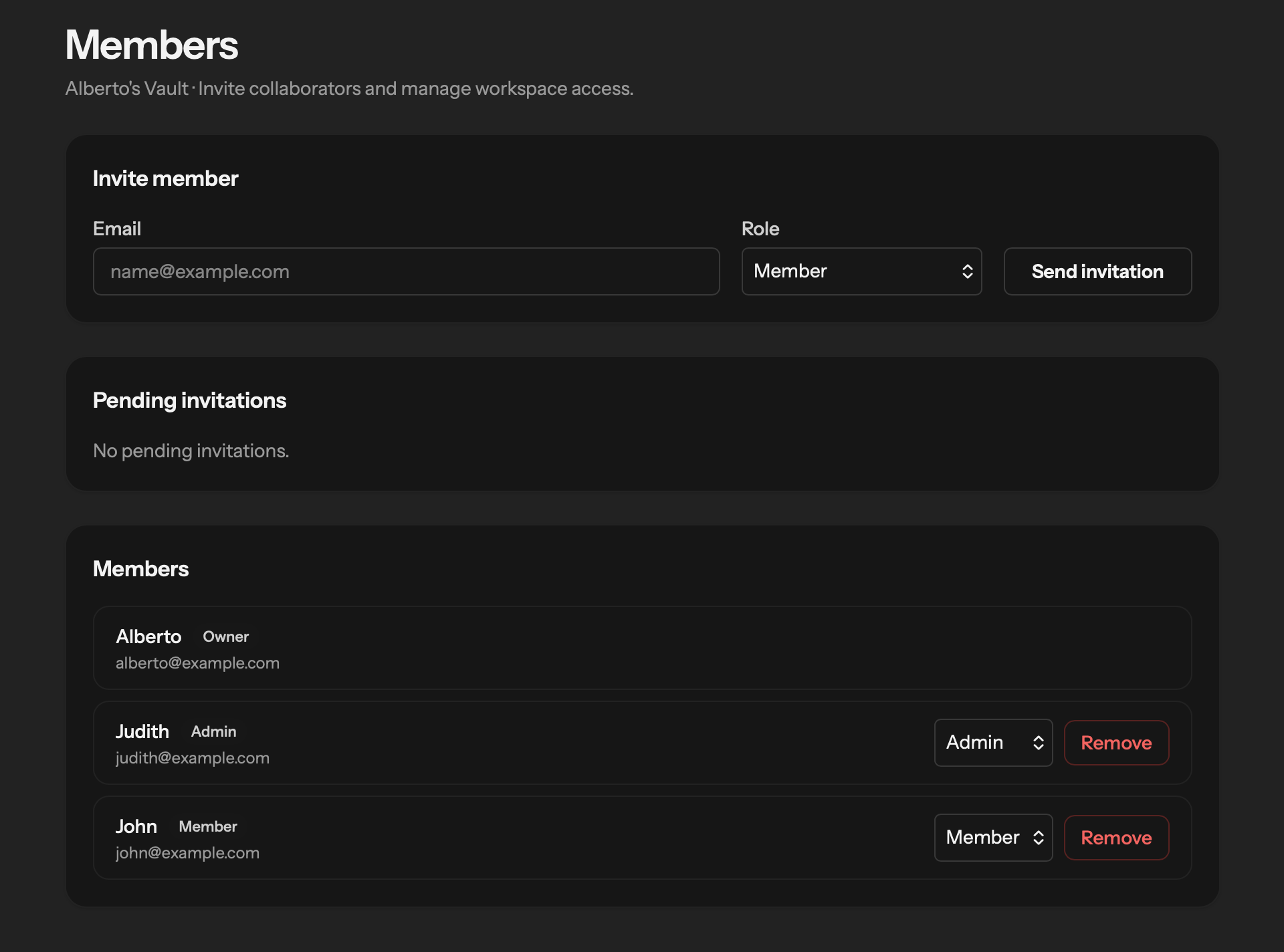
User roles are stored in the workspace membership layer instead of globally on the user. This allows the same user to have different permissions depending on the workspace context: owner in one workspace, admin or member in another.
Invitations and Collaboration Flow
The invitation system introduces a real SaaS workflow: workspace owners and admins can invite members by email, assign a role and bring collaborators into the correct workspace context. The flow is intentionally simple, but structured enough to support future features such as resend invitations, expiration handling or audit logs.
Inventory System
Collections and Items
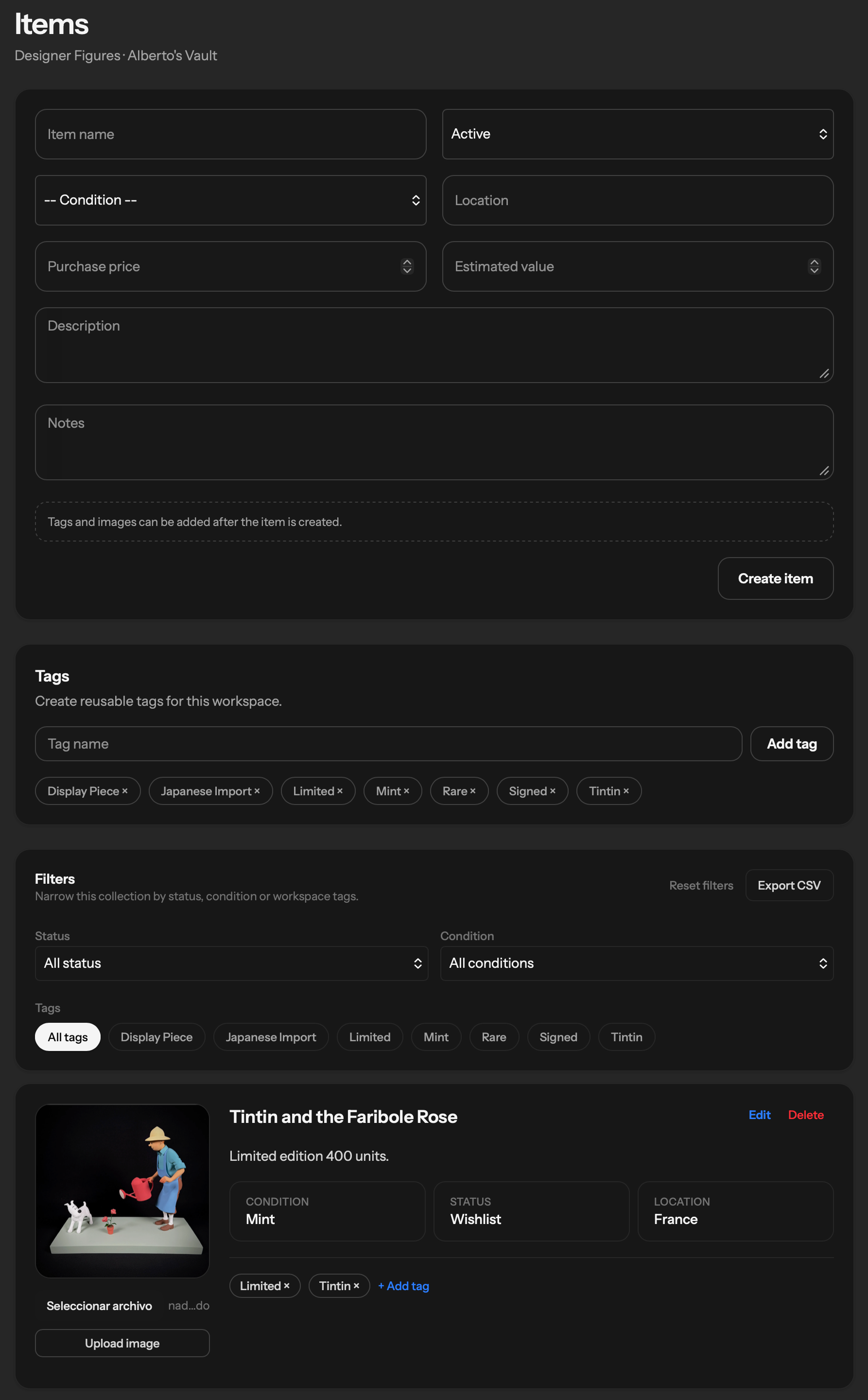
The inventory layer is structured around collections and items. Collections group related assets inside a workspace, while items store the actual inventory data: name, description, status, condition, purchase price, estimated value, location, notes and acquisition dates.
Tags, Filters and Metadata
Tags belong to the workspace and can be attached to items to create flexible classification. Combined with filters for status, condition and tags, the inventory view feels closer to a practical product dashboard than a static list of records.
Business-Oriented Dashboard
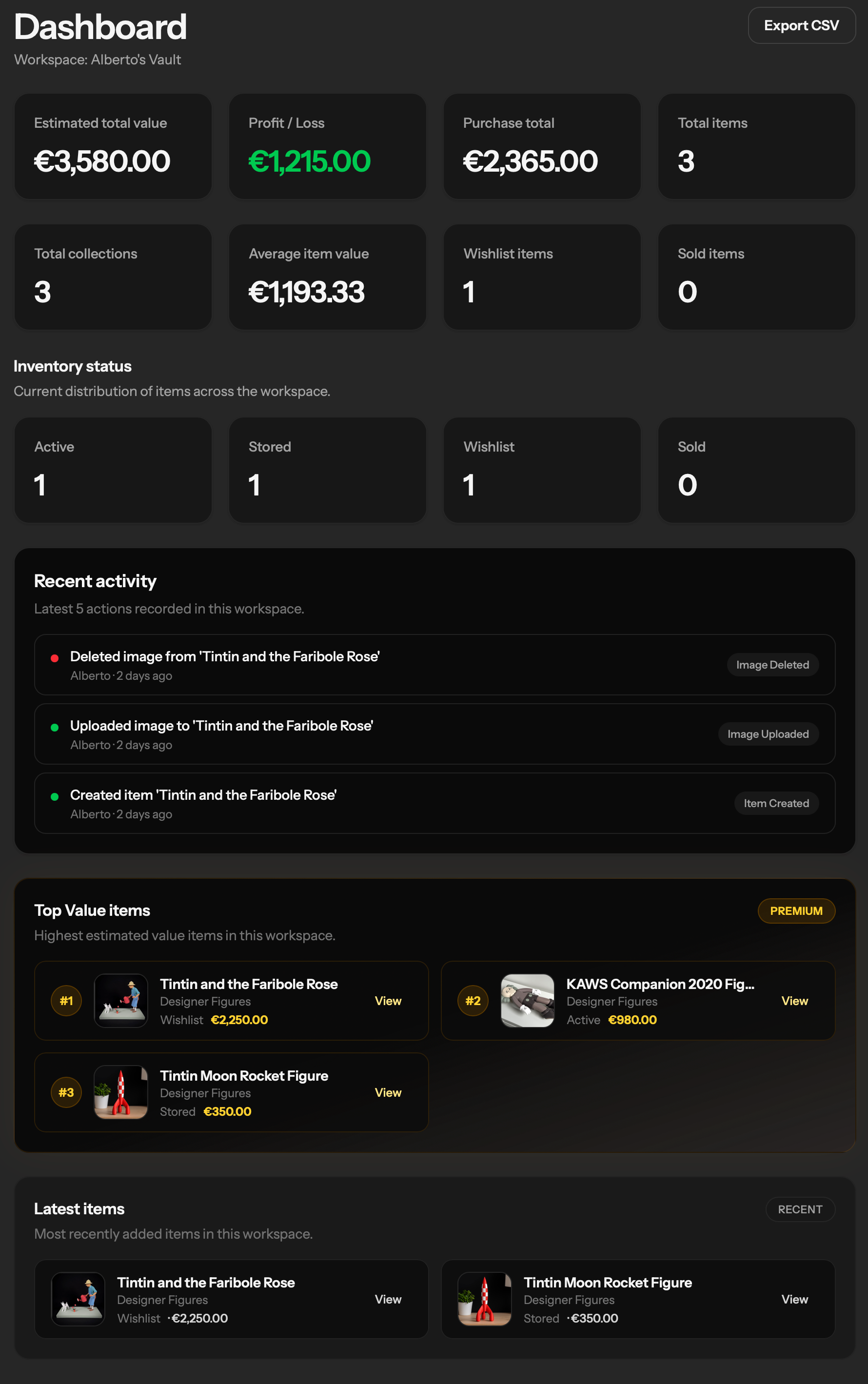
The dashboard summarizes the workspace with practical metrics such as total collections, total items, estimated value, purchase value, top value items and recent additions. This gives Vaulta a stronger product feel and helps communicate the business value of the data.
CSV Export with Active Filters
The CSV export respects the active workspace and the current filters, keeping exports aligned with what the user is actually viewing. This reinforces the SaaS workflow while keeping the implementation simple and Laravel-native.
Technical Decisions
- Workspace-scoped queries: collections, items, tags and exports are always resolved through the active workspace context to avoid data leaks between tenants and keep authorization boundaries clear.
- Roles in workspace memberships: roles are contextual to each workspace instead of being stored globally on the user model. This makes collaboration more flexible and closer to real SaaS products.
- Laravel-first architecture: structural workflows such as workspace switching, invitation acceptance and protected routing are handled with traditional Laravel patterns, keeping critical application behavior predictable.
- Livewire for focused interactivity: Livewire is used where it shines: forms, filters, lists, item management and local UI interactions, without forcing the entire application shell into a single reactive layer.
- Actions and policies for business rules: sensitive workflows such as inviting members or accepting invitations are kept outside the view layer, while authorization rules are centralized through policies and gates.
- Docker-based development environment: the project was developed inside a Dockerized setup to keep the Laravel, MySQL and frontend tooling environment consistent and easier to reproduce.
Technical principle: Laravel handles the structural parts of the SaaS, while Livewire powers focused interaction inside product screens. This keeps the project dynamic without sacrificing maintainability.
Lessons Learned
Building Vaulta reinforced the importance of designing around product boundaries instead of only database tables. The workspace model became the foundation for ownership, collaboration and tenant isolation, which made the rest of the system easier to scale conceptually.
Another important lesson was knowing when to use Livewire and when to rely on classic Laravel patterns. Livewire was very effective for local interaction, but structural workflows such as workspace context, routing and invitation acceptance benefited from a more traditional Laravel-first approach.
The project also highlighted the value of scope discipline. Vaulta could easily grow into a much larger SaaS, but the first version was intentionally kept focused: workspaces, members, invitations, collections, items, tags, filters, dashboard metrics and exports.
Future Improvements
Vaulta was intentionally developed as a focused V1 product. The objective was to build a strong architectural foundation first — workspaces, permissions, inventory structure, collaboration flows and scoped tenancy — before expanding the platform into a broader commercial SaaS direction.
Rather than treating the project as a one-off portfolio exercise, Vaulta was approached as a professional product foundation with clear room for future iterations, subscription systems, analytics, automation workflows and larger-scale team collaboration features.